Want to save cash and upgrade your home? Learning how to install carpet isn’t rocket science.
With the right tools and know-how, you can transform your floors and stay within your budget. We’ll walk you through every step – from prep work to final stretching – so you can tackle the job like a pro.
Roll up your sleeves and get ready to renovate.
Key Notes
- Choose quality tools and materials – the right equipment makes installation smoother.
- Stretching technique determines whether your carpet stays flat or develops wrinkles.
- Stairs need special attention and additional securing methods.
DIY Carpet Installation Tools & Materials
Before starting your carpet flooring installation, gather these essentials:
- Carpet – Measure your space and buy extra for errors.
- Carpet pad – Adds comfort and extends carpet life.
- Tack strips – Holds the carpet in place.
- Carpet knife – For precise cuts.
- Measuring tape & chalk line – Ensures accuracy.
- Carpet stretcher or knee kicker – For a smooth, tight fit.
- Seam roller – Blends carpet seams for a professional look.
- Staple gun– Secures the carpet pad.
- Carpet glue – Needed for concrete installations.
- Transition strips – Smooths edges where carpet meets other flooring.
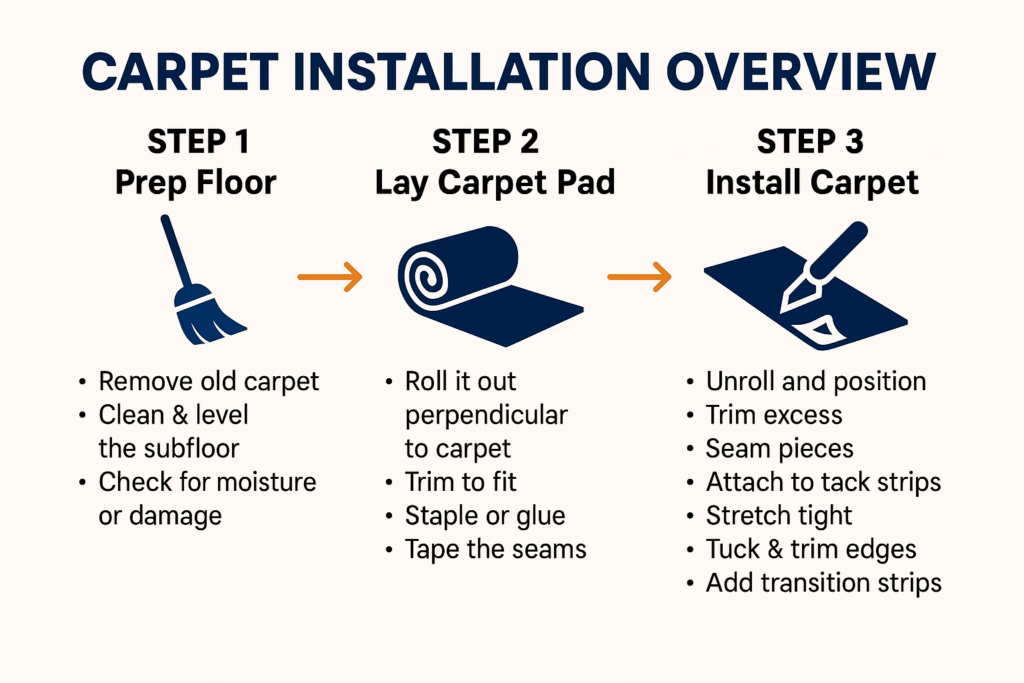
Step 1: Prepare the Floor
A clean, level subfloor is essential for a long-lasting carpet installation.
- 1. Remove old carpet – Cut it into strips and roll it up. Remove tack strips if replacing them.
- 2. Clean the subfloor – Sweep, vacuum, and check for any uneven areas.
- 3. Check for moisture (for concrete floors) – Use a moisture meter. Address high levels before installation.
- 4. Fix imperfections – Fill holes, level dips, and sand rough spots.
Step 2: Install the Carpet Pad
A carpet pad improves comfort and durability. Here’s how to install it:
- 1. Roll out the padding – Lay it perpendicular to the carpet’s direction.
- 2. Trim excess – Cut just short of the walls.
- 3. Secure the pad – Staple or glue it to the subfloor.
- 4. Tape the seams – Prevents shifting over time.
Step 3: Install the Carpet
Now, the main part – fitting and securing your carpet.
- 1. Lay out the carpet – Unroll it, leaving a few extra inches around the edges.
- 2. Trim to fit – Cut excess while keeping a small margin for adjustments.
- 3. Join carpet pieces – If needed, use seam tape and a roller.
- 4. Attach to tack strips – Stretch the carpet over the strips and press firmly.
- 5. Stretch the carpet – Use a power stretcher or knee kicker to remove wrinkles.
- 6. Trim and tuck edges – Cut excess and tuck it into the space between the wall and tack strips.
- 7. Install transition strips – Secure and smooth edges where carpet meets other flooring.
How To Install Carpet on Stairs
Carpeted stairs need extra attention. Follow these steps:
- 1. Measure and cut – Allow extra length for tucking.
- 2. Start at the bottom – Staple or glue the first section securely.
- 3. Use a knee kicker – Push the carpet tightly into each step.
- 4. Secure with tack strips or glue – Choose based on your preference.
Common Mistakes to Avoid
Avoid these pitfalls for a flawless finish:
- Skipping floor prep – An uneven base leads to bumps.
- Not stretching enough – Loose carpet looks messy and wears out faster.
- Bad seam work – Poorly joined carpet pieces stick out.
- Incorrect tack strip placement – If too far from the wall, your edges won’t stay secure. Take your time, use the right tools, and follow each step carefully.
Struggling With Stretchers & Stubborn Seams?
Carpet Maintenance Tips
Extend the life of your new carpet with these care tips:
- Vacuum regularly – Removes dirt before it settles in.
- Clean spills immediately – Prevents stains from setting.
- Use rugs in high-traffic areas – Reduces wear and tear.
- Schedule deep cleaning – Professional cleaning preserves fibers.
DIY Vs. Professional Carpet Installation
| Factor | DIY | Professional |
|---|---|---|
| Cost | ✅ Saves money | ❌ More expensive |
| Time | ❌ Takes longer | ✅ Faster |
| Tools | ❌ Need to rent/buy | ✅ Already equipped |
| Quality | ❌ Risk of mistakes | ✅ Guaranteed results |
| Effort | ❌ Physically demanding | ✅ Hands-off |
Frequently Asked Questions
Can I install a carpet myself?
Yes, you can install a carpet yourself but it takes a bit of patience, effort, and the right tools. Mistakes can be costly, so weigh the pros and cons before deciding.
How do I install carpet on concrete?
If you are installing carpet on concrete, use carpet glue instead of tack strips to secure the pad and carpet. Make sure the surface is dry and level before starting.
How do I replace carpet?
To replace an old carpet, start by removing it along with the padding. Then clean the subfloor, and follow the installation steps above.
Conclusion
Installing carpet yourself can be satisfying—if you’re patient and pay attention to the details.
The prep work might feel tedious, but it’s what makes or breaks the finish. From choosing the right padding to stretching techniques that actually hold, each step plays a part in the final look and feel.
And remember: A power stretcher is the difference between a clean finish and a carpet that waves back at you in six months.
If you’d rather skip the trial-and-error phase, reach out for a free quote. We’ll handle the heavy lifting and leave you with carpet that feels just right.